
Introduction: Why 5702812467 Is Being Widely Reported
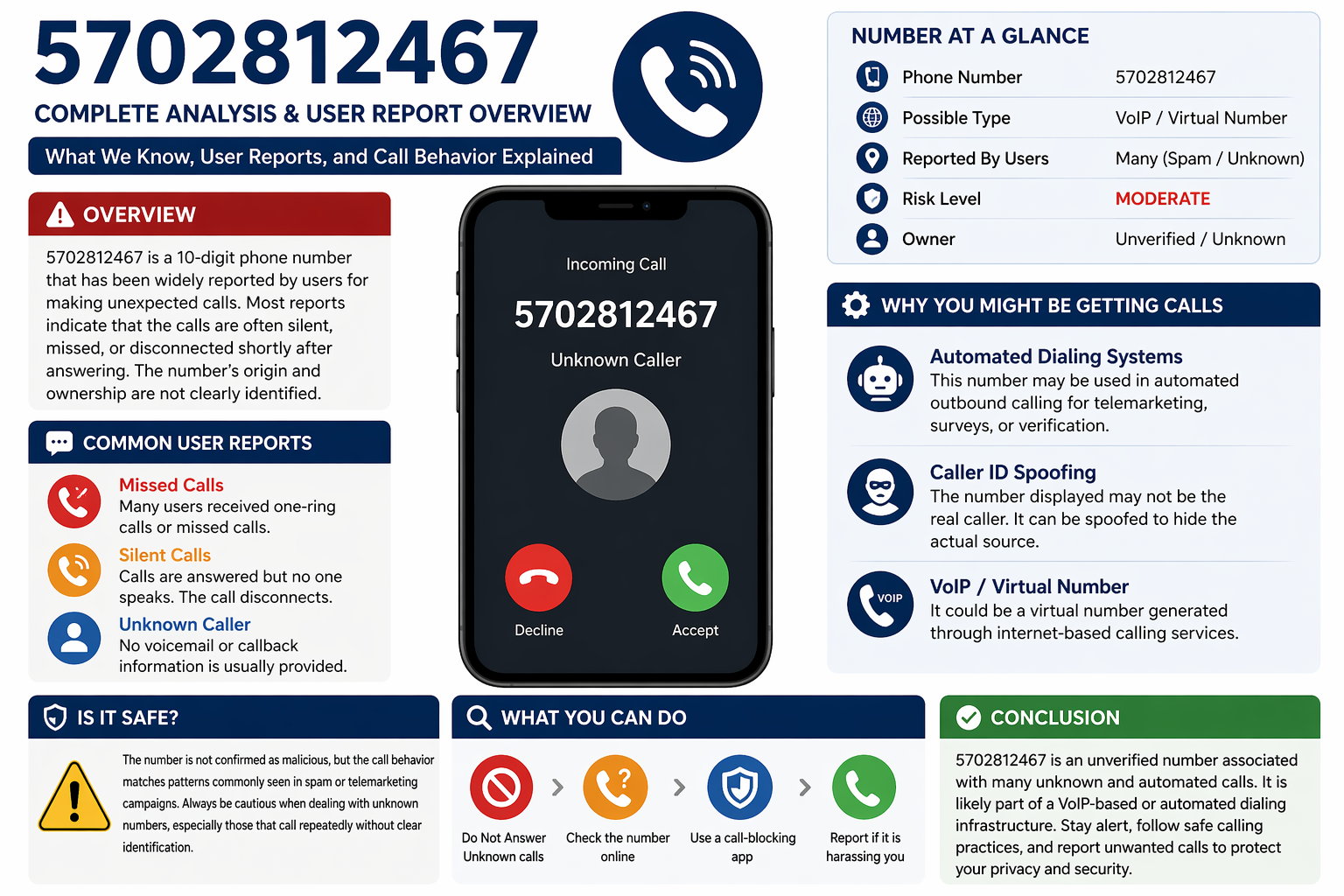
The number 5702812467 has appeared across various phone lookup discussions and user reports because people frequently receive unexpected calls from it. In most cases, users do not recognize the caller, and no clear identity is provided, which leads to confusion and concern.
Modern communication systems allow large-scale automated calling, which means numbers like this can circulate widely without a single clearly identifiable owner. This is why 5702812467 is often searched in “who called me” contexts rather than being linked to a known person or business.
Nature of 5702812467 in Phone Lookup Databases
When numbers like 5702812467 appear in community-based phone lookup platforms, they are usually categorized as unknown, unverified, or potentially spam-related based on user feedback. These platforms collect reports from people who have received calls, helping to identify patterns of unwanted communication.
Such databases do not always confirm ownership but instead rely on repeated user experiences. In many cases, numbers gain attention simply because they generate repeated missed calls or silent calls, which is a common trait in automated dialing systems.
This means the number itself is not necessarily harmful, but its behavior across users determines its reputation.
Why Users Receive Calls from 5702812467
A major reason numbers like 5702812467 appear in call logs is the use of automated dialing systems. These systems are commonly used in telemarketing, survey campaigns, and verification services that contact large groups of numbers in a short time.
Another possible reason is VoIP-based calling infrastructure, where numbers are generated or rotated dynamically through internet-based communication systems. This allows organizations to scale communication but also makes it harder for users to identify the true caller.
In some cases, users report silent calls or one-ring calls, which often occur when predictive dialers connect calls without an available agent.
Silent Calls and Automated Dialing Behavior
Many users associate 5702812467 with silent or missed calls, which is a known behavior in automated calling systems. Predictive dialers work by calling multiple numbers at once and only connecting answered calls to available operators.
If no agent is ready, the call may disconnect immediately, leaving the user with a missed or silent call. This creates confusion because the number appears active but provides no communication.
Research into call center systems shows that this type of behavior is typical of large-scale outbound calling operations, especially in marketing or verification services.
Caller ID Spoofing and Number Masking Possibility
Another important factor in understanding numbers like 5702812467 is caller ID spoofing. This technique allows callers to display a different number than the actual source of the call.
Spoofing is widely used in both legitimate business systems and malicious scam operations. Some companies use it to unify outbound communication, while fraudsters use it to hide their real identity or mimic trusted numbers.
Because of spoofing, the number displayed on the screen is not always the true origin of the call, making verification more difficult for users.
User Reports and Community Feedback Patterns
Across phone reporting platforms, numbers like 5702812467 are often discussed in user-generated databases where people share their call experiences. These reports typically describe missed calls, repeated dialing attempts, or lack of voicemail messages.
Such behavior is commonly associated with automated dialing systems or unverified outbound communication networks. While not every report confirms malicious intent, repeated patterns across users increase suspicion.
Community feedback plays a major role in shaping how unknown numbers are categorized, even when official telecom confirmation is not available.
Telecom Infrastructure Behind Unknown Numbers
Modern telecom systems are built on complex digital routing networks that allow numbers to be assigned dynamically. This includes VoIP systems, cloud telephony platforms, and virtual number pools used by businesses worldwide.
In such systems, a single number like 5702812467 may not represent a fixed physical line but instead a temporary or system-assigned identity. This allows large-scale communication but reduces traceability for end users.
Because of this infrastructure, numbers can appear repeatedly across different regions or users without a consistent ownership identity.
Is 5702812467 Safe or Suspicious?
From a technical standpoint, 5702812467 cannot be automatically classified as safe or unsafe without full telecom verification. A phone number alone does not determine intent; its behavior and usage patterns are more important.
However, repeated user reports of unknown, silent, or unsolicited calls suggest that the number is associated with automated communication activity. This may include telemarketing systems, survey platforms, or call testing operations.
While not necessarily harmful, such behavior is often considered unwanted by users due to lack of transparency.
How Unknown Numbers Like This Should Be Interpreted
In modern communication systems, unknown numbers should be interpreted cautiously but not assumed to be dangerous. Many legitimate organizations use automated calling systems for customer service, verification, or outreach purposes.
However, when a number consistently appears without identification or voicemail, it is usually part of a broader automated dialing network rather than a personal contact.
Understanding this distinction helps users avoid unnecessary concern while still maintaining awareness of potential spam patterns.
Conclusion: The Real Nature of 5702812467
The number 5702812467 is best understood as an unverified telecom identifier commonly associated with automated calling behavior rather than a clearly identified individual or organization. Its appearance in user reports is driven by repeated unknown calls, silent dialing, or automated outreach systems.
While it is not confirmed to be harmful, its behavior fits patterns commonly seen in telemarketing or VoIP-based automated calling infrastructure. Because modern telecom systems allow number masking and dynamic routing, the true origin may not always be visible to the end user.
In conclusion, 5702812467 represents a modern example of how digital calling systems can create uncertainty, highlighting the importance of understanding automated communication, caller ID limitations, and user-driven reporting systems in today’s telecom environment.
